Showing posts with label Alberta. Show all posts

Wednesday, May 8, 2019

May Days in the Bogs

Posted by Kim

     
What is this?  A new post?  Nothing since last July?   What the what is THAT about?

New computers sometimes don't play nice
Well, I'm here to tell you, things have happened, and things are happening now.  Caitlyn and I are just finishing up the start of the Summer 2019 season and it is good to be back doing field work.  Not too many stories (we've seen snow and bears and monster mosquitoes and some kind of Mustelid and almost hit a Kestrel and saw hawks and ravens galore and broke through ice and changed out 72 resin tubes and set 1500 crank wires), but we surely have had a productive time.  Life is somewhat allergy-ridden here for me in Fort Mac as I type, but we are off to Edmonton by tomorrow eve.  Things just keep on moving.   

Here are some pics:


Would Kel be proud?  mmmmm 


Tuesday, June 19, 2018

My First Bog!

Taking a new perspective on the lovely bogs of Northern Alberta, I am a Villanova undergrad helping out with the project this summer.  Eric and I were wide eyed and eager for our trip up North, ready to get our hands and our boots a little dirty.  After cleaning, organizing, and analyzing in the lab we were very excited to see the real thing. 

After a couple easy flights we landed in Edmonton and headed up to Athabasca.  Excited by the saltwater pool at the hotel, we had a fun night before the real work began.  Then, the next day we headed to Athabasca University, prepping for all our sites: constructing the sippers, cutting boardwalk pieces, and getting all the materials we needed.  Then, after a long day at the garage, we got a good night of sleep and headed up to Fort Mac.  On the way, a site near Conklin was scouted, but to no avail.  We did get to see our first bear of the trip (kind of accidentally) as we were turning around to plan what to do next.  It ended up being a day off due to the new site not being what we were looking for (sigh).  So, the true fieldwork had to wait one more day.  We got up to Fort Mac, a little confused at how such a bustling town can be this far North, but actually really liked the town's unique charm.
Boots and Bogs


So, Friday comes and we head to MacKay to tackle the first site.  With Kel's and Kim's crash course in everything bog related, we were ready for veg collection.  We quickly learned the difference in root color of Fuscum and Capillifolium, had to scrape off Ledum from our gloves (the new growth is pretty sticky in early June), and tried not to get too stuck in one of the wetter bogs we went to over the week.  While it took some practice and quite a few questions, Eric and I quickly became pros at spotting all 10 species we were gathering.  With the help of SIU, Caitlyn, Yev, Kristen, Kim. and Kel, we cruised through veg and water collections at MacKay and then went to JPH4 where we got that finished pretty quickly as well.  I had never been in a bog before so I got quite a few pictures after I figured out my best path so that I wouldn't get stuck.


Eric at MacKay
The Mighty Kel
The next day was our first new site day.  We arrived at the site which we named Kearl and loaded up as much as we could to take out closer to the site.  As Kim mentioned, we had already seen a bear on the way and it was pretty clear that this is one of the more "off the beaten path" sites.  It was a hot and steamy day so we got to work right away to hopefully finish a bit early.  We hammered a lot of nails, pounded in posts, and set up everything pretty quickly on the site.  Then, with the help of SIU we struggled through getting veg for the sites (a couple of the samples were hard to find at some of the plots) and started packing up to get back to Fort Mac.  That's when Jeremy called us about the bear.  With this being the first wild bear I had seen while I am not in a car, you would think I would be cautious and careful, but no, I pulled out my phone to get a good video of the bear instead.  After a bit I realized, wow that was dumb, and pulled out my bear spray instead.  But, the bear sauntered on by and left us alone.


JPH4
The last three sites, McMurray Bog, Anzac, and Horse Creek, all went without too many problems and the rest of the week was pretty smooth sailing.  McMurray Bog was pretty dry on the walk out there and no one went for an unintended swim, the rain wasn't too strong at Anzac, and the Horse Creek setup went quickly now that we were pros at setting up a site. 
I was honestly a bit sad to leave Fort Mac, but was excited by the thought of our nice hotel beds waiting for us back in Athabasca.  We then made quick work of wrapping things up and headed back to Philly and the lab.  Overall, I know both Eric and I learned a lot being out in the field as well as had a good time with it.  Other than a few less horseflies, no complaints from me.  I can't wait to get back up there next month!!
The Bear!!

A new fan of peatland bogs,

Spencer

Friday, May 18, 2018

We're on a Mission: On a Mission for Bogs


Tasked with scouting new sites for our project, we were excited to be on our own.  New bogs, here we come!  I love walking through bogs and today we planned to hit several.  The sun was shining, we had Tim Hortons in our bellies, hot tea in the thermos, and noises of Fort McMurray were soon behind us.  Armed with black and white printouts from Google Earth and a sense of adventure we set off southbound with our ‘bog-eyes’ on. 
Every so often, this happens… we expand a project or find a new project and all of a sudden, we’re out driving around in the truck with our boots on ready to stop at every peatland with potential.  We get out, walk around a bit, give it the thumbs up or thumbs down, and move on.  Today we had prepared for a few sites. 

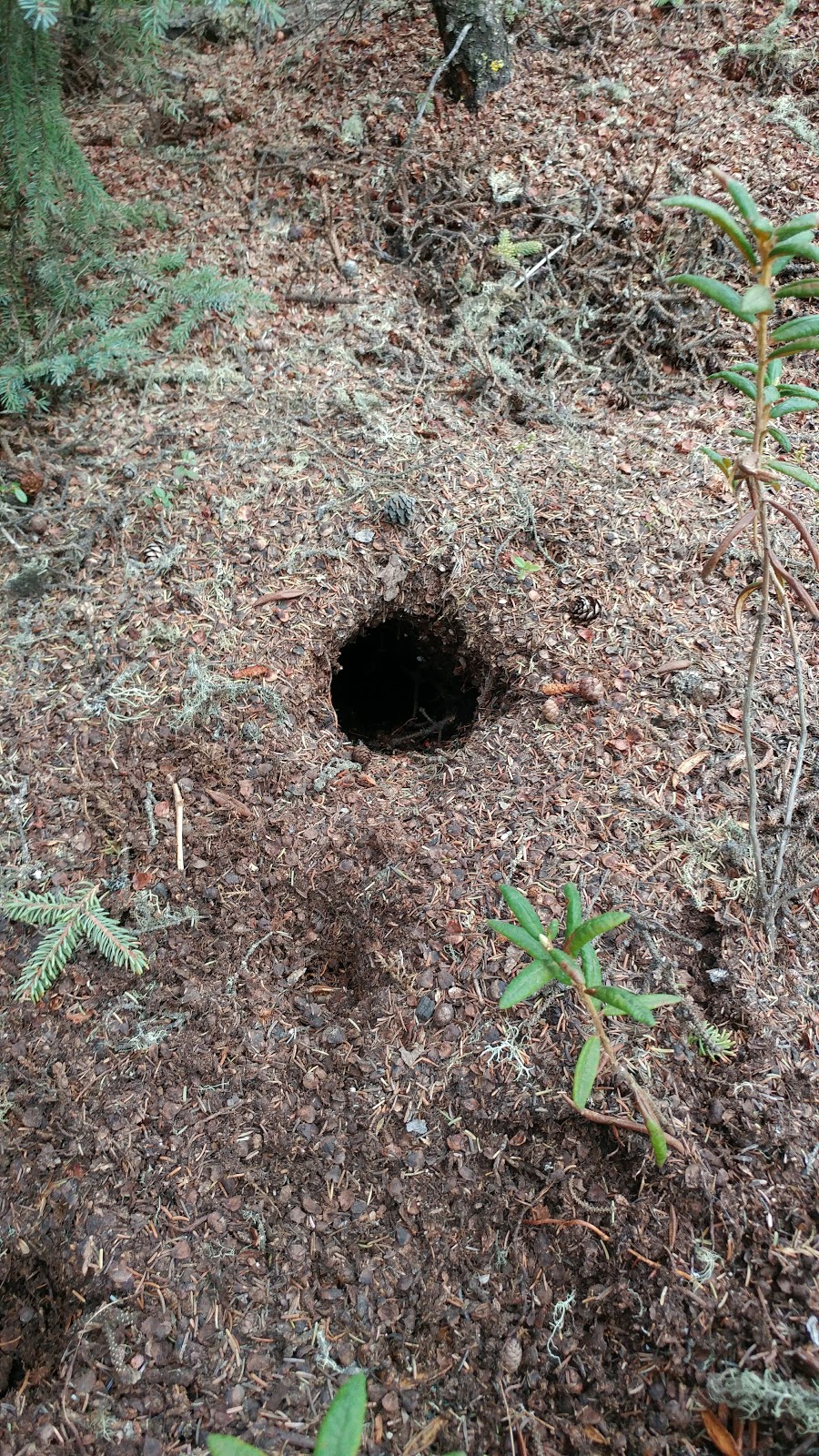
The first bog of the day was out a sandy rutty road which was precariously positioned steps from a very large lake seemingly retained by a small berm… cattails flanked the north side.  It has been dry here for quite some time, so we had no problems; the visual, however, was a bit disturbing.  The bog was also right there on the road – just how we like them.  We stopped and put on our boots with two out of three of us squishing a bit from yesterday’s soakers.  The woods were lovely dark and deep and almost immediately we stumbled upon an animal burrow – something we are unaccustomed to seeing.  The openings – 12-15 cm diameter or so – seemed just right for a mustelid of some kind.  Pretty cool stuff.  Full of puffy feathermoss and big black spruce trees, it was not the bog we were looking for, but it was very pretty and after a bit of exploration, we wished it well.  We moved on:  the piece de resistance was yet to come.

Our big goal that day was a fen-lake-bog islands combo.  We should have known it was going to be trouble.  Step one:  finding the road.  We missed it on first pass because we were informed it was a paved road.  It wasn’t.  That’s ok, we went down another road, instead, and found a whole lotta’ VERY DUSTY bogs that could have been delightful were it not for the choking dust haze squelching everyone’s happiness.  We backtracked and found the correct road.  We check in with the woman who is sitting in her truck all day flagging people down to take their numbers and tally business.  Up and down big hills, over one lane tiny bridges, we pass beautiful landscape and countless Jack Pine forests, Aspen uplands, fens, and little bogs.  We pass very few trucks, and eventually, became the only traffic.  Fifteen miles down the dirt road, we stop on the side of the road and hope against all hope that this is the spot.  We only have our odometer and our satellite imagery at this point, foolishly leaving our gps at home.  There is no cellular service here.  We are in the middle of nowhere.  We can only assume we’ll come on it eventually if we walk south from here.

So, we start in.  Brambles.  Lots and lots of prickly brambles.  I’ve never been so mad at wild roses in my life.  They were mixed in with drooping, criss-crossing, akimbo, skinny, branchy, shrubby crap that morphed into full-fledged willow mess at decreasing elevation.  We were scratched, irritated, and realized we should have brought lunch on this adventure.  With willows came wet.  Sloggy mess morphed into treed sloppy mess with holes ready to take a boot.  Avoid trees, avoid willows, avoid holes, slap at bugs, overheat, repeat.  Finally some boggy parts – hummocks, thank God!  But still willows and still larch now and still sloggy holes and not at all what one might want for a scientific research site that must be accessed 5 times a year.  By now, we were demoralized and quite frankly were growing stupid (save your jokes).  We had done way too much fen tromping, willow avoiding, and bramble broaching and now were too tired to truly explore the innards of the Bog island, but from our vantage, we saw big ole’ larch overhead much farther in (in bog parlance, again…. No bueno).  We headed back hoping to find a better route.  

We found cutlines in the fen, so knew where we were and tried a more bee-lined approach to the road.  It took us, eventually, to a beautiful – and I mean BEAUTIFUL – forest of spruce so dense, it shaded out the world.  There were no vasculars in the understory, but Pleurozium moss carpeted the floor.  Everything was covered with it.  We had found what appeared to be a two species forest.  I’m sure there were more species there, but you get the idea.  It was dark and calm and beautiful and amazing.  We sighed a sigh, calmed our brains, and gathered our strength for tackling the brambles to come.  At the edge, Ledum of unusual size appeared, and willows began anew.   We had definitely found a much better way to scale the upland.  Everything seemed better on the way out.  Shockingly, we popped out AT OUR TRUCK.  Amazing.  We filled our water bottles, breathed the air, ate apples, and made peanut butter and jelly sandwiches on the tailgate.  Deer crossed the road, we recovered, and looked at each other with relief.

We had an adventure filled memory-making day.   I'm sure there are many to come.  Happy return to field season, everyone!

Friday, January 19, 2018

Veg Picking Doldrums

I heard on NPR the other day that Moscow had its darkest month ever recorded with only 6 minutes of sunshine for the entire month of December, 2017. This, down from an average of 18 hours of sunshine/month. I’m having a hard time imagining either scenario.  That said, it has felt terribly dreary this winter with some pretty serious cold temps keeping us inside a lot of the time.  Our inside winter jobs have kept us busy in our pursuit to finally catch up on a backlog of samples and as the lab chugs along and the days grow longer, we start thinking about the upcoming field season.

We will have a busy field season, and I think I can speak for us all when I say that we look forward to getting outside into the wilds and out of our veg cleaning doldrums.   


Friday, October 13, 2017

Snow!

our deer family at the house
Posted by Kim
No bears.  No moose.  Instead, we saw two Bald Eagles, a Northern Harrier, a Rough Legged, countless un-ID-ed buteos, a handful of deer, assorted ducks, a fleet of snow geese, bevies upon bevies of Ruffed Grouse, one coyote, one coyote poop, one bear poop, one dead red squirrel, Wood Buffalo behind a fence, and conspiracies of Ravens.  It seemed a little slim on the wildlife this trip, but I suppose we shouldn’t complain  - we also didn’t have to leave a site because of wildlife, so that is good.

every step: deeper snow
We did, however, experienced our fingers go red and numb, our toes ache, and beautiful snow-covered landscapes.  For the second year in a row we have done fieldwork in the snow.  Now, I love snow; there is no denying that, but even I get a little nudgy when I have to read crank wires when there is snow.  First you have to find the crank wires – they are wires sticking up from the moss 4-8 cm and they were completely snow covered. Then you need to clear out the snow from them gently with your fingers in the 20 degree weather, put a ruler on them, and measure them at ground level.  We were lying down in the snow a lot and our hand-warmers got some good use.  It was cold, but it was also fun.  Challenges doing fieldwork are part of the gig and that’s part of what makes it so endearing.

the crew

We have a great crew this trip and everyone has been nothing but positive about pretty much everything.  And the things that get complained about are things like unnecessary use of hose clamps and such – not the cold, or the hours, or being squished in the truck.  I’m proud of us all –especially after we froze our bippies off yesterday.    We are all looking forward to heading home tomorrow, but we’ll also be a little sad to leave the snowy beautifulness here in Alberta.  Another year pulled from the calendar and we hope the next will be filled with even more field work.  Keep your fingers crossed.

Wood Buffalo


Monday, October 9, 2017

Our Endless and Proper Work

Posted by Kim

There is a deep grey to the gloam this morning and it is likely to rain today here for a bit.  Snow for tomorrow.  Snow yesterday. Snow likely today somewhere.  It has been cold.  But today is Thanksgiving, and we will celebrate it warmly even if first we venture out with toe-warmers at the ready.  Crow Lake is on the docket for today and it is full of treachery. 

We polled last night and it has won the Site-Least-Liked award.  Crow Lake burned around 2000 and so the trees that died then are akimbo, losing their vertical.  The peat has lost integrity producing pools in which many boots are lost: soakers, we call them and sometimes they come in quick succession pulling both boots off unsuspecting undergraduates.  You stop.  You pull your boot(s) out of the dark sodden hole.  You pour the water out, hope for the best, and move on.  The walk into the site from the road is also quite terrible and we’ve lost two folks up to their armpits.   We now are very aware of where that hole lives. 

In contrast, we have two beautifully green and vibrant sites near Wabasca, Alberta – a short drive from Athabasca where our base of operations remains for now.  I have grown to love them both.  The oldest of our sites, Wabasca old, is full of surprises and, as far as bogs go, is pretty diverse.  The trees are dense, which made plot layout a challenge, and this trickles down to me wandering around almost every time I’m there to make sure I’m at the right spot.  Mosses run roughshod over fallen trees and climb up living trees making the spruce throw out new roots in order to survive.  It is a silent battle out there that hardly anyone sees or understands, but we speak some of the language and we try to listen and learn. 

Field work is a comfort to me (even though I may grumble about the cold or the bugs or the snow or the rain) and I have missed it this summer.  It is good to be back in the field and among the mosses so plenty. I’m reminded of a ditty written by Mary Oliver.  This is but a bit of it:

The green mosses, being so many, are as good as brawny.

How important it is to walk along, not in haste but slowly,
looking at everything and calling out

Yes! No! The


swan, for all his pomp, his robes of grass and petals, wants
only to be allowed to live on the nameless pond. The catbrier
is without fault. The water thrushes, down among the sloppy
rocks, are going crazy with happiness. Imagination is better
than a sharp instrument. To pay attention, this is our endless
and proper work.
  

Happy Thanksgiving to especially our Canadian friends.

Wednesday, May 24, 2017

The Smell of Fort McMurray in the Morning

Posted by:  Kim


Welcome to Field Season 2017!

    Starting it off with a bang, Kel and I are tackling Fort McMurray sites and doing a fine job of it.  No bugs, no rain, no sun, no problem.  Actually, there were bits of each of those things today, but we weren't counting.  Day one went great and we look forward to tomorrow's adventure.   
 Sorry for the tease, but I'm making this short and sweet.  We have some planning to do for tomorrow and some good Fort McMurray food to find for dinner.  We'll have plenty to talk about soon.  It has been too long.  We've all missed the mosses and I'm excited to share scoop on our summer plans and what has been going on over the winter.     For now, I can assure you - the mosses are still here and it makes me happy to be walking among them - so lavish and green.


Monday, July 11, 2016

 Posted by Kim

Black Spruce cones form in clumps high up on branches near the tops of trees.  They are considered serotinous. That is to say, these specialized trees depend on fire to help release their seeds to the world.  The trees bear slowly-opening cones for 25 - 75 - 100 years until a fire sweeps through to rapidly open the cones to disperse their seeds to the charred peat.   They have evolved to survive in a world in which fire is expected – and up here, that return interval is estimated at just over 120 years.   You would be hard pressed to find spruce trees older here in the bogs of Alberta, and we can tell you where a few are, but they are rare rare rare.  We also think that the fire return interval is likely shrinking.  Fires are predicted to increase in intensity and to happen more often. This is all part of the climate story of the world.  

The Fort Mac fire has recently been categorized as being held, and it has surely released a multitude of black spruce seeds – many in our study sites.  It has also burned a bit of our equipment and more importantly, some beautiful landscape is now black and crunchy. The town itself seems to be recovering as well.  They don’t let you into the residential areas that were nearly completely demolished, but the town seems to be chugging along with most things back open.
 
I just spent a few days there with Caitlyn and Wendy and we rolled along the truck-filled roads with our aim on science. We breathed in bad smelling air and watched stacks billow brown tinged ‘steam’.  The big business of oil sands was back up and running.

At Anzac, the first site we visited, the constant buzz of bugs was punctuated by helicopters carrying water bucket after water bucket to nearby hotspots.  Bright green Cloud Berry leaves and Labrador Tea plants were starkly tender on the charred peat; and a month post fire,  where I stood, life was returning.

Along with Anzac, McMurray Bog was also partially burned with the Black Spruce taking the brunt of the damage at both sites. Another site, Mildred, was a total burn.  Two other sites were left unscathed and wait for the next fire to open their cones.  The science moves on. 

These bogs are resilient and I am glad to see that life springs anew sometimes even because of great tragedy.  We will return again in a few weeks and I'm sure we will find new and green freshness springing from darkness.


Wednesday, May 25, 2016

Bears, Fluxing, and Fert

Well, the fire still burns, but we are busy with our fieldwork and the team is gaining momentum.  Two teams today split up and one fluxed and one fertilized.  It was a busy, successful day.  We had hoped to get to Fort McMurray by now, but access is still restricted and so we continue to focus on our NSF project.

By my count, we have collectively seen at least 4 bears – one of which came walking by our front door and explored the yard.  That is a seriously respectable number for our short stint  up here thus far.  We’ve seen a host of fox, several coyote, tons of deer – some of which have decided to race our trucks and then cut us off – some of which are in our front yard.  We’ve seen so many birds of all kinds, and squirrels and we’re pretty sure there is a wolf skeleton at one of our sites.  We are teaming with all kinds of wildlife and I hope to see more. 

I’m at the end of my first trip up here for the summer, but really it is just the start for us all.  The crew is great - Tough and Smart and Funny and hard working and they still seem to all be enjoying themselves, so that is a good start.  

Cheers to a great summer!   


Wednesday, May 18, 2016

Mildred Burned

Posted by Kim

Well, we are pretty solid on our Mildred site burning pretty much as I type this.  It is located very close to the Syncrude/Suncor main stacks and ponds as you can see in the satellite image below.  We had hoped to wander up in that direction tomorrow, but it is looking less and less likely that we will be able to visit any of our sites up there for quite a time.  We will keep you updated.


To the right you can see the overall fire activity this morning.  Today we plan to hit our Red Earth Creek and Utikuma sites which happen to be the furthest sites west and away from this area.  There appears to be a small fire under control north of Red Earth Creek, however, it seems like those sites are all in the clear. 

In other news, it is good to be here in Athabasca again, and the weather is projected to be a lovely 80 F and sunny today.  It is a good day to do field work, but probably not a great day to fight fires.  Keep your fingers and toes crossed.

Sunday, May 15, 2016

Science On

Thanks, Kelly, for your great update yesterday!   Athabasca has been our home for a long long time and I look forward to joining Kelly and Hope on Tuesday to start our field season.  Our hearts go out to the people of Fort McMurray, many of whom still do not know if they have homes still standing or a place to return to.  They all wait for word that they can head back to Fort McMurray to see what the fire has left them.

We, too, await word.  We are starting our field season, and it is shaping up to be an odd and possibly treacherous one.  Field work, in general, trends to the tenuous, and we have had to wait to get up to some of our sites before because of fire, but this year is beyond precedent.  We have two sites that may have burned.  We won’t know until we show up.  One is just south of the airport and one is just north of Anzac.  The MODIS satellite imagery has them both questionable. Our sites are the green dots in purple lettering.
Two of our bogs (green dots) amid a see of yellow, orange, and red dots indicating age of fire with red being most recent...  Image was taken off Google Earth May 5th.  The fire has spread into and off the borders of this image since.
This fire season is already in full swing and it is only May.  This year it officially started in March, and since then, the area has seen 30+C weather and a paucity of rain.  The fire threat is Extreme for all of our field sites currently, and the Fort McMurray fire is still burning, and, as of this morning, is just over 251,000 hectares large with several areas still out of control.  There are currently over 1,000 firefighters and firefighting personnel, 134 pieces of heavy equipment, 39 helicopters, and 11 airtankers working on this wildfire, alone.  It remains impressive and devastating and we are holding our collective breath.

All this being said, we are still looking forward to the new field season and I’m excited to get the crew together to start our work this year in the Boreal.  We return to the house where we were last year, and are lucky to do so.  Our colleagues have not been so lucky – some of whom have lost houses in Fort Mac or the ability to get up to the area to do any of their research.  At least we have several projects still in unburned areas and we can start our work.  I expect there may be some camping happening in the Fort Mac area this summer, as housing will be terribly tight.

We will be sure to keep an eye and nose to the sky and earth as we roll from site to site this summer - especially paying close attention to where we park hot trucks.  Bogs tend to hold onto fire deep into the peat, and so we will be vigilant and mindful of the potential for fires everywhere.   For now, we will do our best to keep the science moving forward.  Sites have burned in the past and sites will burn again in the future and there is always room for more questions to be answered.  So…. With that in mind: 


 Science on, crew!  


We hope to be diligent about our updates this year, so stay tuned!


Posted by Kim

Thursday, May 21, 2015

Field Work Time!

A doe and her twins visit and eye us slyly from the yard:  we are their new neighbors at the bottom of the hill that angles sharply up to Athabasca University.  Instead of 18-wheelers and rowdy road workers waking us up in the mornings (last year’s motel fun), I found myself this morning moaning about an industrious woodpecker that roused me a tiny bit too early.  Our digs have improved by orders of magnitude.  Athabasca University has again made our arrival so welcoming; and this summer, we hang our hats in a building they own and maintain.  It is nestled among trees and open space and we are making it our own until our season ends this fall.  The kitchen has a commercial gas stove with 6 burners, two fridges, two sinks, two dishwashers, 1 gas oven, and 2 convection ovens.   Need I say more?  We are living in luxury.  A big shout-out to the folks that have been working so hard to make our arrival such a wonderful experience.

Our crew is arriving in two waves this year.  I am here with 5 other folks and we have been fixing things, settling in, and prepping for the summer.  The second wave arrives on Saturday (two days!) and includes not only a seasoned grad student (hey, Julia!), but also our new crew of field techs who will be experiencing bogs for the first time!  Logistically, it is a tricky thing to balance airport runs, maintenance work, site construction, and isolated research tasks, so this year we decided to mix it up with airport runs.  We look forward to the whole crew’s arrival so we can start the summer fun.  Meanwhile, today, a small group of us are heading up to Fort McMurray to set vegetation growth markers, swap out precipitation collectors for the summer and put together a new site.  We hate to leave our cushy digs in Athabasca, but we look forward to squishing through the bogs.  Our first site up is a bog we call Anzac.  It is one of my favorites. 
This is an image of part of our walk to the site, but we have yet to arrive there-- right now I am in the truck and I am happy to report that we just passed a bear – our first bear of the season!  Construction continues on the road to Fort McMurray and bear sightings along this strip are fewer than they used to be as there is a lot more dust and big construction vehicles to deal with. We will have a very busy day tomorrow as we head into the Fort Mac area where the construction is ridiculous and the air is even more dirty, but we look forward to the work and visiting our old bog friends. 

Welcome to Alberta 2015!!!

Sunday, October 13, 2013

A Meanook Fall

Aspen in October.  At Meanook.
Posted by:  Kim

The troops are flying back to Canada today for the last trip of the season – they are actually on the plane as I type, after (not surprisingly) a bit of a delay at PHL.  October trips are usually my favorites, but this year, I am holding down the fort.  For me, bending over for long periods of time and carrying heavy equipment through squishy sodden -- yet beautiful -- peat is frowned upon by the powers that be right now.  Sigh.  I’ll miss the bright yellows and oranges of the aspen, larch, and birch swimming in the deep blue of the Alberta skies and I’ll especially miss the camaraderie of good friends doing fieldwork.  I’ll miss the berries and the foraging bears and the wild eagles.  The weather for this trip looks fantastic.  I am sure they will have a great time.

I will also miss, perhaps, my last chance to say goodbye to Meanook.  Our September trip was a busy one, filled with both field work and dismantling nearly 15 years of equipment and memories from a place we've called home for a very long time.  The Meanook Biological Research Station is closing.  We accomplished our field work in September; and then, systematically moved our equipment and tools out of Meanook.  Under the heavy weight of recent budget cuts, the University of Alberta has decided to step away from the field station, with the Department of Biological Sciences breaking ties with us and other external researchers associated with the station.  It has not been a smooth extraction, to say the least. 

Syncrude plant located just north of Fort McMurray. 2013.
Steven Harper, the Prime Minister of Canada since 2006, and the government of Alberta, are no friends to education, arts, the environment, or scientific inquiry.  With a power base in Alberta, Harper is changing the landscape in Canada in ways both metaphorical and literal.  Massive budget cuts have been imposed on countless institutions and researchers on a national level, and scientists have not only been defunded and disbanded, but they have also been actively muzzled.  Alberta, as a lightning rod for this new Conservative party mentality, now functions, along with the whole of Canada, with a bleaker, heavily petroleum based-economy.  Harper and his party actively shunt money now to industry, establish increased subsidies and reduced regulations to oil companies and their ilk, while systematically cutting funding for, and eliminating, jobs and resources to scientists and educators.   Scientists can no longer do their jobs (even if they have them), and continue to be limited in their ability to disseminate real data and information. Meanook, an outpost for scientists near the oil sands region, is closing.  It is not the first research station in Canada to fall under this new reality (far from it), but it is near and dear to us all; and as we struggle to reestablish a new paradigm for our own research needs, we hope we can help keep Meanook functioning in any way we can.  For now, our hands are tied.

Meanook
While we were able to continue our research based out of Meanook this past summer, it will be our last unless something is done and done quickly.  I have spent large chunks, if not all, of my summers at this research station since 2002, and much of our team comes back year after year.  We’ve seen managers and cooks come and go, but through it all, Meanook is home, and a place to not only do science, but it is where we meet up with old friends who have turned into family.  The closing of the Meanook Biological Research Station is not only another jab at making scientific discoveries more difficult in the shadow of the oil sands region, but on a personal note, as researchers and human beings, it breaks our hearts.

We have hope that another entity will pick up the baton and carry it forward, but for now, we are struggling through upheaval and chaos. 

If you have some time, please read about what is happening to our northern Canadian colleagues.  For our research team, the effects are palpable, and for the Earth, it is a disaster buried in the smog.  

A FAR from exhaustive list of links that may be of interest:


Saturday, May 25, 2013

Boards and Plots


It was the third full-out field day today.  Bruised and sore, we are kicking some serious plot-building butt.  I am so proud of this team we have.  They are without complaint even when I know they are exhausted and are pushing themselves places they usually would never go.  In this group, we have three undergraduates with us for their first year of bog fieldwork;  Mikah, Anita, and Brian have been incredible and it will be a great year with them on the team.   

We have hauled 510 10’ pieces of lumber from here to Red Earth Creek.   We haven’t quite finished with 170 of those that need new homes tomorrow after finding their angle of repose tucked into the trees about 200 meters down the cutline.  That is almost a mile of 10-foot pieces laid end to end.  This lumber is now distributed across a few sites, and we’ve another 170 to go at a new site early next week.  Slogging through the soupy mosses, while an excellent workout, is not the easiest thing in the world.  I give our team giant props for being such good sports.  Everyone has bruises on their shoulders and sore muscles everywhere, but a few more days of this and we can get onto the fun less painful stuff. 
 
Postings may be scarce here while we exhaust ourselves, but all is well in the grand scheme of things.  Fires are burning here and there, but nothing to cause us worry.   Hopefully will keep you all updated as we move through this first phase of the summer.  

Happy bog-walking!

Kim

Sunday, May 19, 2013

The Early Crew


If I didn’t know it was only May 19th, I would say it is at least mid-June here in Alberta.  A small contingent of our group arrived at Meanook early this year, and we are just driving back from Fort McMurray as I type.  It has been in the upper 70’s near 80 for days, and we were just caught in a very summer-like downpour that came out of nowhere.  The rain felt good.  Sadly, with the heat comes mosquitoes…  the big bomber-type are out and ready to bite through pants and protective long-sleeved shirts.  I clapped one dead, opened up my hands, and it flew away unperturbed and chomp-ready for its next victim… these things are beasts.  Already, myself, Nate, and Cara itch from the buggers, and I fear we are in for it early with the bugs.  Usually, we can count on at least a couple of weeks before the nets come out, so we shall see.  I’m sure it will be a rude welcome on Tuesday for the new members of our team when they show up.

Meanook is ready for them.  Rooms are prepped, and April, the new cook for the summer, has our dietary restrictions noted, and is ready for the considerable challenge.  This will undoubtedly be Meanook’s last year and I’m sure there will be more about that peppered throughout the summer, but for now, it remains a home away from home for me and for a contingent who has been coming here for several  years.  It is at least my 11th or 12th summer - I've sort of lost track.  It has been an establishment for our research group since before I can remember and we have accumulated just as much equipment as one would think after so long a time.  It is a nice place to hang your hat and with the Victoria Day holiday here in Canada, it is quiet, but that will change with a blink of an eye with the imminent arrival of several crews.
My last post included much about the birds and so I’ll just finish up on this long day by saying that we saw Northern Shrikes (yes, Shrikes, Kel!!) at EVERY site we visited on this quick trip north.  It was good to see them eyeing us and chatting to their partners.  White throated sparrows sparred with Chippings in feeding flocks rounded out with boreal chickadees and fat robins.  Magpies bobbed from ground to fence and back and ravens are everywhere.  We’ve seen several deer, a coyote, and have been serenaded by the comb-click of boreal chorus frogs.  Thankfully, it is nearly summer for more than just the mosquitoes. 

Safe Travels, crew!  We will see you soon. 

Monday, March 4, 2013

Welcome

Welcome to the 55th Parallel.  Our ecological research in Canada takes us above and just below the 55th parallel in Alberta, and in the summer, we utilize our 17 hours of sunlight to the fullest. In the winter, when thankfully we aren't busy up there, the sun is above the horizon for not quite 7 hours.  It is a great place to work if you can fend off the black flies and bears -- and there are plenty of both.  The wetlands in which we work are teeming with life of all kinds, and these systems are beautiful.


This blog's inspiration comes from wanting to share some of what we know and some of what we experience while doing research both here at VU and in Canada.  We are exposed to some great people, fascinating terrain, and quality research.  Throughout the next few months, in particular, as we delve into the busy summer field season, we'll share what is happening with us and our group and we welcome feedback and insights.
Our research takes us primarily to Alberta Canada where we focus on disturbances both anthropogenic and natural.  We work in peatlands, which in this part of the world, are dominated by treed bogs and both treed and open fens.  Within these wetland systems, we work to tease apart nutrient cycling under the umbrella of fire, pollution, and climate change scenarios.  We do this because peatlands store vast amounts of carbon and other nutrients, and it is this carbon that could potentially be released back into the atmosphere, given changing conditions, thus further contributing in some way to global climate change.


We hope to share with the world (and friends and family) why these systems are so incredibly important, our love for the ecosystem, and the science that drives it all.  We will have posts from graduate students, undergraduates, professors, technicians, and hopefully some interesting guest writers.

And so, welcome.